
Expanding into a new iGaming market can look like an incredible business opportunity. A growing population, increasing smartphone adoption, and rising interest in digital entertainment
Read More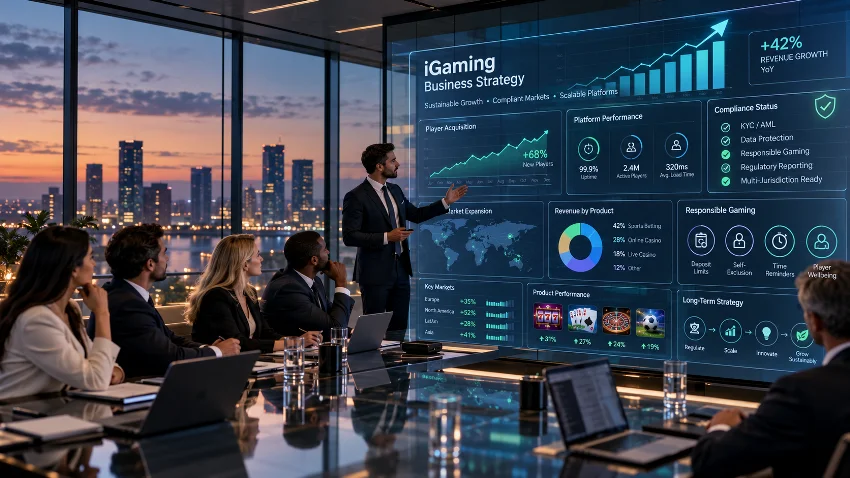
iGaming Business Strategy: Advanced Guide to Growth and Compliance
The online gaming industry has evolved into a complex digital business environment where technology, financial management, regulatory compliance, and customer protection influence long-term success. Operating a competitive platform requires more than attractive games or sophisticated marketing.
A well-developed iGaming Business Strategy connects commercial objectives with licensing requirements, operational resilience, and responsible gambling practices. Businesses must understand how market conditions, software infrastructure, payment systems, and regulatory expectations affect their performance.
This comprehensive guide explores advanced management frameworks, growth planning, financial analysis, technology development, and compliance strategies for building reliable and sustainable operations in regulated online gaming markets.
1. Understanding the Modern iGaming Business Landscape
The iGaming sector includes online casino services, sports betting, digital bingo, and other regulated real-money gaming activities.
These business models operate through different commercial structures, but they share several important requirements: reliable technology, financial controls, regulatory oversight, and consumer protection.
Understanding these foundations is essential before pursuing expansion.
Market Structure and Industry Economics
Online gaming businesses generally operate within highly regulated environments where licensing obligations influence nearly every operational decision.
According to the UK Gambling Commission’s September 2026 industry statistics, Great Britain’s remote casino, betting, and bingo sector generated approximately £8.3 billion in gross gambling yield during April 2025–March 2026.
Online casino activity accounted for around £5.7 billion of that figure.
These numbers demonstrate the sector’s commercial scale, but they should not be interpreted as evidence that every operator can achieve similar profitability.
Gross gambling yield represents the difference between stakes received and winnings paid, subject to the regulator’s reporting definitions.
It is not equivalent to operating profit.
Technology costs, taxation, supplier fees, compliance expenditure, personnel expenses, and other obligations can substantially affect financial outcomes.
Understanding Different Business Models
Some companies operate consumer-facing platforms, while others develop gambling software or provide specialised business services.
A business-to-consumer operator manages customer accounts, payment experiences, product access, and relevant regulatory responsibilities.
Business-to-business providers may supply gaming software, platform infrastructure, compliance systems, or analytical technology.
The distinction matters because operational risks and licensing requirements can differ considerably.
For example, a software provider may focus primarily on technical reliability and certified game functionality.
A consumer-facing operator must also manage identity verification, customer communications, financial transactions, and player protection procedures.
Companies should select a business model that aligns with their technical expertise, financial resources, and ability to maintain regulatory compliance.
2. Developing a Strong Regulatory and Licensing Framework
Regulation is one of the most important factors influencing online gaming operations.
Licensing requirements determine where businesses may legally operate, which products they can offer, and what safeguards must be maintained.
A company holding a licence in one jurisdiction does not automatically have permission to serve customers elsewhere.
Evaluating Licensing Jurisdictions
Before entering a market, businesses need to understand its legal and regulatory environment.
Important considerations include licensing eligibility, permitted gaming activities, ownership requirements, taxation, reporting obligations, and consumer protection standards.
The UK Gambling Commission’s Licence Conditions and Codes of Practice establishes requirements for relevant licensed activities in Great Britain.
Its provisions cover subjects including customer verification, technical standards, financial controls, marketing, and social responsibility.
The framework is updated periodically, meaning ongoing regulatory monitoring is essential.
Businesses should obtain qualified legal advice before entering unfamiliar markets.
Relying on general internet summaries can create serious compliance risks, particularly when local rules change.
Establishing Compliance Governance
Effective compliance requires more than appointing a legal adviser shortly before launch.
Organisations need clear responsibilities, documented procedures, and management oversight.
A compliance officer may coordinate regulatory reporting, policy development, internal training, and the investigation of potential breaches.
However, accountability should extend across departments.
Product teams need to understand technical restrictions, finance teams must follow applicable transaction requirements, and marketing departments must comply with advertising rules.
Regular internal reviews help identify weaknesses before they become major operational problems.
A well-structured governance framework also supports transparency when regulators request information.
Preparing for Regulatory Change
Gaming regulations evolve as governments respond to technological developments and evidence concerning consumer harm.
New requirements may affect product features, financial checks, advertising practices, or reporting arrangements.
Companies should maintain a structured process for monitoring relevant consultations and regulatory updates.
For example, an upcoming technical standard may require modifications to game interfaces or transaction records.
Identifying the change early allows teams to evaluate implementation costs and schedule necessary adjustments.
Regulatory preparation is generally more effective than making urgent changes after a compliance deadline.
3. Building Reliable and Scalable iGaming Technology

Technology plays a central role in delivering secure and consistent online gaming services.
Customers expect platforms to function correctly across devices, but regulators also require appropriate safeguards and reliable technical operations.
Infrastructure planning must therefore address performance, resilience, and accountability.
Designing a Scalable Platform Architecture
Modern digital platforms often depend on interconnected systems for account management, transactions, game delivery, reporting, and monitoring.
A modular architecture can make these components easier to maintain and update.
However, separating services introduces additional complexity.
Each component requires dependable communication, appropriate authentication, and carefully managed access permissions.
For example, a platform may use dedicated services for identity verification, payment processing, and game transactions.
This arrangement can support operational flexibility, provided system dependencies are understood and monitored.
Scalability should be evaluated through realistic workload testing rather than assumptions about advertised server capacity.
Understanding Technical Gaming Standards
The UK Gambling Commission’s Remote Gambling and Software Technical Standards establish requirements for relevant licensed operators and software providers.
These standards address areas such as customer account information, game rules, random outcomes, transaction displays, and security.
Random number generation is particularly important for games where outcomes depend on random processes.
Appropriate testing helps establish that systems operate according to applicable technical requirements.
Businesses should work with competent, appropriately recognised testing services where required.
A visually impressive platform provides little commercial value if its underlying systems cannot meet technical or regulatory expectations.
Improving Reliability and System Monitoring
Operational interruptions can damage trust and create complications involving incomplete transactions.
Platforms need effective monitoring for service availability, transaction processing, database performance, and system errors.
Incident management procedures should explain how teams respond to technical failures.
For example, if a transaction is interrupted, the platform should maintain reliable records and resolve the outcome according to applicable rules.
Regular backup testing and disaster recovery exercises help organisations prepare for unexpected disruptions.
The objective is not merely achieving high advertised uptime.
It is maintaining dependable services and accurate records during normal operations and system failures.
4. Strengthening Cybersecurity and Payment Integrity
Online gaming platforms process sensitive information and financial transactions.
This creates responsibilities involving data protection, authentication, transaction security, and fraud prevention.
Weak controls can expose customers and operators to substantial financial and reputational consequences.
Protecting Customer Information
Sensitive information may include identity records, account credentials, financial details, and transaction histories.
Organisations should apply appropriate security controls throughout the information lifecycle.
Encryption, access restrictions, monitoring, and secure authentication contribute to a layered defence.
The UK Gambling Commission’s technical security requirements reference relevant elements of ISO/IEC 27001:2022.
These controls help establish structured approaches to protecting important systems.
However, cybersecurity cannot be reduced to purchasing a security product.
Businesses need documented responsibilities, regular assessments, secure software development, and employee training.
Maintaining Payment System Reliability
Payment experiences influence customer confidence and operational stability.
Transactions should be recorded accurately, processed through authorised channels, and reconciled against internal financial records.
Operators should clearly explain applicable payment conditions and avoid misleading information concerning withdrawals.
Strong reconciliation procedures can identify discrepancies between transaction records and payment provider reports.
For example, finance teams might compare daily transaction totals with settlement reports and investigate unexplained differences.
These controls support accounting accuracy and help identify potential operational problems.
Payment arrangements must also comply with applicable financial and gambling regulations.
Managing Fraud and Financial Crime Risks
Gambling services can face financial crime risks, including attempts to misuse customer accounts or payment systems.
The Financial Action Task Force’s September 2026 report on gaming and gambling discusses emerging financial crime risks associated with digital and cross-border activity.
A risk-based approach evaluates relevant customer, transaction, geographic, and product characteristics.
Businesses should establish appropriate identity checks, transaction monitoring, and escalation procedures.
Potential concerns require careful assessment rather than automatic assumptions of wrongdoing.
Financial crime controls should be proportionate, documented, and aligned with legal obligations.
5. Integrating Responsible Gambling Into Business Operations
Responsible gambling is an essential component of regulated gaming operations.
Businesses must consider how their products, customer interactions, and commercial decisions affect the risk of gambling-related harm.
A sustainable operating model cannot treat consumer protection as an optional marketing feature.
Designing Effective Player Protection Systems
The UK Gambling Commission’s customer interaction guidance emphasises three connected activities: identifying potential harm, taking appropriate action, and evaluating effectiveness.
These principles encourage operators to recognise concerning circumstances and respond appropriately.
Depending on local requirements, safeguards may include spending limits, time-related reminders, account restrictions, and self-exclusion arrangements.
Such features should be accessible and understandable.
Businesses should also ensure customer service teams are trained to recognise and escalate relevant concerns.
Protective measures need to function as intended, not simply appear in policy documents.
Using Data Responsibly
Operational data can support the identification of circumstances associated with potential customer harm.
However, automated systems should not be treated as infallible.
Customer circumstances vary, and unusual behaviour does not always have one explanation.
A responsible framework combines appropriate monitoring with documented review procedures and human oversight.
Businesses should assess whether interventions actually reduce risk.
Data analysis must also respect privacy obligations and avoid unnecessarily intrusive practices.
The objective is meaningful protection rather than collecting information without a clear purpose.
Aligning Business Incentives With Consumer Safety
Commercial performance measures can create conflicts if employees are rewarded exclusively for customer spending.
Management should ensure that incentives do not undermine responsible gambling obligations.
For example, staff should not be encouraged to discourage customers from using legitimate account restrictions.
Protective actions should remain effective even when they reduce short-term revenue.
Organisations can incorporate compliance quality, complaint resolution, and safeguarding effectiveness into management reviews.
This broader approach strengthens accountability across the business.
6. Creating Compliant Marketing and Brand Development Strategies

Marketing in regulated gaming markets operates under stricter conditions than many other digital industries.
Businesses must consider advertising restrictions, consumer vulnerability, age requirements, and promotional transparency.
A strong brand should communicate reliability without encouraging harmful or misleading expectations.
Establishing a Responsible Brand Position
Brand positioning should reflect genuine service qualities.
These may include transparent information, accessible customer support, reliable technology, and clear product terms.
Operators should avoid suggesting that gambling provides dependable income or solves financial difficulties.
The UK Gambling Commission explains that advertising must be socially responsible and comply with applicable advertising codes.
Marketing claims should therefore receive appropriate compliance review before publication.
Clear language and accurate product descriptions can reduce misunderstandings.
Reputation is built through consistent customer experiences rather than exaggerated promotional promises.
Managing Affiliate and Third-Party Relationships
Some licensed operators work with external publishers or marketing partners.
These arrangements create additional oversight responsibilities.
Contracts should define permitted promotional activities, disclosure requirements, compliance responsibilities, and monitoring expectations.
Operators should also review whether third-party content accurately represents their products and terms.
For example, an affiliate advertisement describing a promotion should not omit material restrictions.
Businesses need procedures for correcting or removing non-compliant marketing materials.
Outsourcing advertising activity does not necessarily eliminate the operator’s regulatory responsibilities.
Evaluating Marketing Performance Responsibly
Marketing effectiveness should not be evaluated solely by customer deposits or immediate revenue.
Compliance incidents, complaints, misleading messaging, and exposure to prohibited audiences are also important considerations.
A campaign generating short-term revenue may create greater long-term costs if it violates advertising requirements.
Management should establish review processes that combine financial accountability with appropriate consumer protection measures.
Marketing reports should distinguish legitimate commercial outcomes from activity that creates regulatory or reputational risk.
This helps organisations make decisions that support responsible long-term operations.
7. Understanding Financial Management and Sustainable Growth
Financial performance in gaming businesses depends on several interacting factors.
Gross gambling yield, operating costs, taxes, technology expenditure, and regulatory obligations influence profitability.
Understanding these relationships is essential when evaluating business sustainability.
Analysing Gross Gambling Yield
Gross Gambling Yield, commonly abbreviated as GGY, is an important industry reporting measure.
A simplified calculation is:
GGY = Total Stakes Received − Total Winnings Paid
Consider a hypothetical reporting period involving £10 million in stakes and £9.4 million in winnings.
The resulting GGY would be £600,000 before relevant adjustments.
However, this amount is not equivalent to net profit.
Businesses must account for applicable taxes, supplier payments, personnel expenses, infrastructure, compliance costs, and other operating obligations.
Management should therefore avoid equating transaction volume with financial success.
Building Realistic Financial Forecasts
A financial model should consider several possible operating conditions.
A base-case forecast may represent management’s most supportable assumptions, while alternative scenarios examine weaker revenue or higher operating costs.
For example, an operator might evaluate how increased regulatory expenditure would affect available cash.
Management could also consider the consequences of delayed platform development or changes in supplier pricing.
Forecasts should distinguish fixed expenses from costs that vary with activity.
This helps identify how the business might perform under different conditions.
Accurate financial planning supports responsible investment decisions.
Controlling Costs Without Weakening Safeguards
Cost efficiency is important, but indiscriminate reductions can introduce serious risks.
Reducing essential security monitoring, compliance staffing, or customer protection resources may create expenses far greater than the immediate savings.
Businesses should first examine operational inefficiencies.
Duplicated processes, underused software subscriptions, and poorly coordinated supplier contracts may provide opportunities for improvement.
Automation can reduce routine administrative work when implemented carefully.
However, critical controls must remain effective and subject to appropriate oversight.
Financial resilience depends on protecting essential capabilities while managing resources responsibly.
8. Developing Long-Term Expansion and Governance Strategies
Business growth requires more than entering additional markets.
Successful expansion depends on regulatory eligibility, operational readiness, financial capacity, and consistent governance.
A disciplined approach can reduce unnecessary exposure to legal and commercial uncertainty.
Evaluating New Market Opportunities
Market attractiveness should be examined alongside licensing feasibility and local requirements.
A jurisdiction may offer strong apparent demand while imposing obligations that significantly affect the business model.
Management should assess whether existing technology, payment arrangements, and compliance systems can satisfy the new market’s standards.
Cultural and language differences may also influence customer support requirements.
Expansion plans should incorporate realistic implementation costs.
An attractive revenue forecast provides limited value when the necessary operating conditions cannot be met.
Establishing a Risk-Based Growth Framework
A growth framework should identify potential financial, operational, legal, and reputational risks.
Each risk requires a defined owner, evaluation method, and appropriate response.
For example, entering a new jurisdiction may introduce additional reporting duties and different advertising restrictions.
The expansion team should determine whether current processes can meet those requirements.
Management can then evaluate whether the opportunity justifies the required investment.
This approach supports more informed decisions than relying exclusively on market-size estimates.
Strengthening Leadership and Accountability
As organisations expand, leadership responsibilities become more complex.
Executives need accurate information about operational performance, compliance concerns, financial results, and consumer protection outcomes.
Regular management reviews can identify whether departments remain aligned with strategic objectives.
Independent assurance and internal audit functions may also support accountability.
Employees should understand how to report concerns without inappropriate pressure.
A strong governance culture encourages early problem identification rather than concealing difficulties until they become severe.
9. Building a Future-Ready iGaming Operating Model
The gaming sector continues to evolve alongside developments in digital infrastructure, consumer expectations, and regulatory policy.
Businesses need the flexibility to adapt while maintaining stable core controls.
Future readiness depends on carefully evaluating innovation rather than adopting every emerging technology.
Applying Data Analytics and Automation
Data analytics can support operational reporting, system monitoring, financial reconciliation, and compliance assessments.
For example, automated dashboards may help management identify changes in technical performance or unresolved service incidents.
However, analytical results require appropriate interpretation.
A statistical pattern does not automatically establish causation.
Businesses should document data sources, model limitations, and review responsibilities.
Automation is most valuable when it improves accuracy and consistency without weakening human accountability.
Investing in Operational Resilience
Resilience involves maintaining essential functions during unexpected disruptions.
Organisations should periodically evaluate critical technology dependencies, supplier arrangements, and recovery procedures.
A supplier outage may affect customer services even when the primary platform remains operational.
Contingency plans should therefore address important external dependencies.
Incident simulations can help identify communication gaps and unrealistic recovery assumptions.
The objective is to make disruption management predictable, organised, and accountable.
Measuring Business Excellence Beyond Revenue
Revenue remains important, but it does not fully describe operational quality.
Management should also consider service reliability, financial controls, customer complaint resolution, compliance performance, and the effectiveness of protective interventions.
A balanced performance framework helps leaders understand whether growth creates additional vulnerabilities.
For example, higher transaction volumes accompanied by increasing unresolved complaints may indicate operational strain.
The company should investigate the underlying cause rather than assuming increased activity always represents progress.
Long-term succes depends on delivering trustworthy operations while meeting commercial and regulatory responsibilities.
An effective iGaming Business Strategy combines regulatory compliance, reliable technology, financial discipline, and meaningful player protection. Sustainable growth requires operators to understand market economics while maintaining strong governance and responsible business practices.
Start by reviewing your organisation’s licensing obligations, operational risks, and financial controls. Build measurable improvement plans, strengthen internal accountability, and prioritise long-term reliability over short-term expansion that could compromise consumer protection.
Disclaimer: This article is intended for educational and business research purposes only. It does not constitute legal, financial, or licensing advice. Gambling regulations vary by jurisdiction, and licensed operators should consult qualified professionals and relevant regulatory authorities before undertaking regulated activities.